The green transition is no longer just an encouraging slogan; it has become a mandatory operating standard for the logistics industry globally as well as in Vietnam. As the government commits to achieving net-zero emissions by 2050, the pressure to reduce carbon footprints weighs heavily on transport businesses—where fleet operations account for the largest share of emissions.
In this context, how can businesses maintain delivery performance and minimize environmental CO₂ emissions without eroding profit margins? The answer lies in the digitisation of operational processes, specifically the application of a Transportation Management System (TMS) to optimize routes.
This article provides a deep professional analysis of how a TMS solves environmental challenges through data and algorithms, while opening up a sustainable green transition roadmap for B2B logistics businesses.
1. The quantitative link between transport distance and CO2 emissions
To clearly understand the role of a TMS, it is first necessary to look directly at the nature of emissions in road transport. The CO2 emissions of a fleet are directly proportional to fuel consumption, and this consumption depends directly on three variable factors:
- Total distance traveled: The longer the distance, the more fuel is burned.
- Idle time: Traffic congestion or waiting times at warehouses cause engines to run continuously without producing useful work, increasing wasted emissions.
- Empty miles: Vehicles returning without cargo are among the biggest causes of resource waste and useless emissions in the logistics industry.
According to emission standard studies, a medium to heavy-duty diesel truck emits an average of approximately 2.68 kg of CO2 per liter of fuel consumed. Therefore, any solution that cuts out 1 km of excess travel or 1 minute of idling directly reduces resource consumption and greenhouse gas emissions into the atmosphere.
However, manual route optimization—relying on dispatcher experience or Excel spreadsheets—can no longer handle the complexity of modern logistics. Increasing order volumes, stricter on-time delivery requirements, and constraints regarding delivery time windows, road weight limits, or vehicle-restricted zones demand computational capabilities that far exceed manual processing power.
2. Core TMS mechanisms supporting carbon emission reduction
Modern TMS solutions go far beyond digitising documents or tracking vehicles on a map. To serve sustainability goals, a TMS intervenes deeply in the planning and dispatch stages through intelligent algorithms.
Dynamic route optimization
Instead of manual planning based on a dispatcher's experience, a TMS utilizes algorithms to solve the Vehicle Routing Problem (VRP). The system automatically calculates thousands of transit scenarios based on:
- The location of delivery and pickup points.
- Customer time windows.
- The actual capacity and volume of each vehicle.
- Real-time traffic conditions.
The result is the shortest possible transit route, avoiding chronic congestion points and optimizing delivery sequences to ensure vehicles move continuously at peak efficiency.
Load optimization
The TMS analyzes the dimensions and weight of cargo packages to arrange truck bed space in the most scientific manner. Maximizing the capacity of each trip helps businesses reduce the total number of vehicles deployed on the road. Delivering more goods with fewer trips is the most direct way to reduce the emission intensity per unit of cargo CO2 per ton-km.
Empty miles mitigation
Through comprehensive visibility across the entire transport network, a TMS connects inbound and outbound freight demands. The system automatically suggests backhaul orders or coordinates vehicles to collect cargo on their return routes. Eliminating "empty miles" not only optimizes revenue but also completely eliminates unnecessary emissions.
3. Real-World efficiency of TMS in green operations
When deploying a TMS into actual operations, transport businesses record clear shifts in their energy and environmental control metrics:
Operational Metric | Traditional Method | Operations via TMS | Environmental Impact |
Distance Traveled | Qualitative, dependent on drivers | Optimized by automated algorithms | 10% to 15% reduction in total distance |
Empty Mile Rate | High, lacking backhaul visibility | Automated backhaul matching on routes | Cuts wasteful emissions on return legs |
Waiting Time | Difficult to control at unloading docks | Accurate appointment scheduling (Slot booking) | Reduces engine idling time at warehouses |
These figures prove that investing in TMS technology delivers a double benefit: it slashes variable costs (fuel, tire wear) while helping businesses accumulate green credentials and transparent emissions reports—a massive competitive advantage when bidding for international B2B projects.
Carbon measurement and reporting
Beyond operational optimization, a TMS serves as the data foundation for emissions measurement. The system records actual mileage, fuel types consumed, and the payload of each trip—thereby calculating CO2 emissions according to internationally recognized methodologies, such as the GLEC Framework or ISO 14083.
This capability is particularly vital when businesses need to report Scope 3 emissions to partners or comply with increasingly stringent ESG regulations.
4. TMS deployment roadmap towards Net Zero for Vietnamese logistics businesses
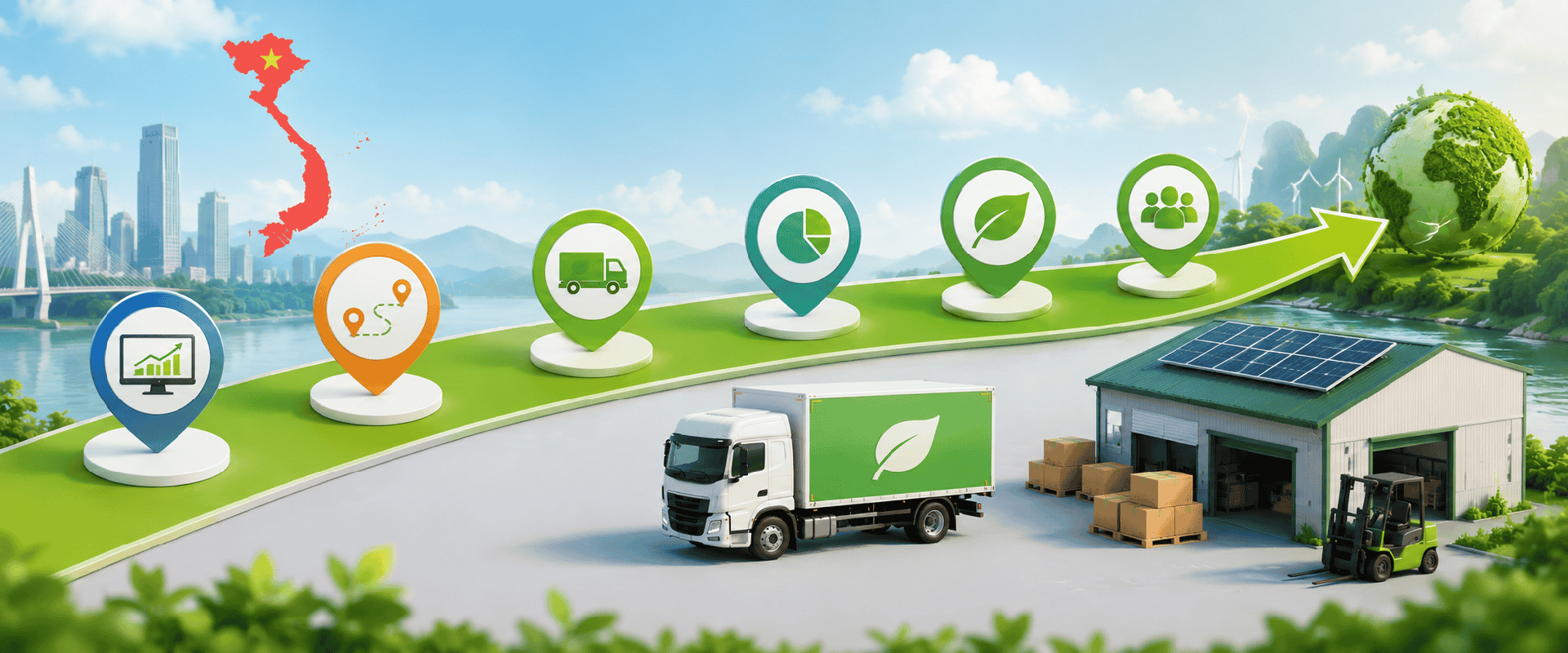
Phase 1: Transport data digitalisation
The first step is moving from manual transport management to a digital platform. Businesses need to digitalise all data regarding orders, routes, vehicles, and operational costs. This serves as the foundation for any subsequent optimization steps to be executed.
Phase 2: Deploying automated route optimization
Once comprehensive data is established, businesses can implement the route optimization module within the TMS. This phase focuses on reducing total mileage, minimizing the number of trips, and increasing payload factors—delivering a double benefit: reducing fuel costs and cutting emissions.
Phase 3: Integrating carbon measurement
Businesses then add a module for calculating and reporting CO2 emissions, integrated directly with real-world operational data from the TMS. The outputs are utilized for ESG reporting, meeting requirements from international partners, and establishing a baseline for annual emission reduction targets.
Phase 4: Continuous optimization and scaling
With data accumulating over time, businesses can apply advanced analytics and machine learning to continuously improve routing efficiency. Concurrently, the scope of optimization can expand into other areas of the supply chain, such as modal shift selection, warehouse network optimization, and green fleet management.
5. The ROI question: Reducing emissions does not conflict with business efficiency
A common concern among Vietnamese logistics companies is the investment cost of green technology solutions. However, real-world evidence shows that route optimization via a TMS delivers a positive ROI right from the initial stages of deployment:
- 10% to 20% reduction in fuel costs by shortening total mileage and minimizing vehicle idle time.
- 15% to 25% increase in fleet productivity through schedule optimization and efficient freight consolidation.
- Lower vehicle maintenance expenses as a direct result of reduced overall operational wear and tear.
- Enhanced competitive advantage by meeting strict ESG criteria demanded by international clients.
In other words, reducing CO2 emissions and optimizing operational costs are two sides of the same coin. Businesses do not have to choose between profitability and environmental responsibility—a TMS makes it possible to achieve both.
6. The role of deployment partners in the transformation journey
TMS technology can only achieve maximum efficiency when deployed in alignment with the specific operational characteristics of each business. The Vietnamese logistics industry features its own distinct traits: a highly fragmented delivery network, uneven transport infrastructure across different regions, and a significant variance in the level of digital maturity among enterprises.
This is why choosing a consulting and deployment partner with hands-on experience in the Vietnamese logistics sector is crucial. Sota Solutions is a pioneer in consulting and deploying TMS solutions for logistics enterprises in Vietnam. They provide comprehensive partnership from process assessment and solution design to full system deployment and ongoing operational support.
With extensive experience working alongside domestic transport and logistics businesses, Sota Solutions understands the market's specific challenges—ranging from integrating a TMS with existing ERP systems to training operational teams to adapt to new workflows. This expertise is a deciding factor that helps enterprises shorten implementation timelines and achieve tangible business results more rapidly.
7. Conclusion: Net Zero is not a distant goal—If you start the right way
Vietnam's Net Zero 2050 target sets a clear requirement: every economic sector, including logistics, needs a specific and measurable emission reduction roadmap. Route optimization via a TMS is one of the most highly feasible steps—delivering immediate economic benefits while directly contributing to long-term carbon reduction goals.
Logistics businesses do not need to wait until they possess electric fleets or hydrogen fuel technologies to take action. With a properly deployed TMS system, achieving a 10% to 15% reduction in CO2 emissions through route optimization is entirely attainable today.
Contact Sota Solutions today to receive an in-depth consultation on your TMSdeployment roadmap, optimize fleet capacity, and build a sustainable logistics foundation for the future.