An international freight order has just been signed at a competitive rate. Just two days later, the operations team announces unexpected demurrage charges at the port, directly eroding the shipment's profit margin. Sales blames operations for being inflexible and slow to respond; operations insists sales provided incorrect gate-in schedules and misunderstood actual port regulations.
This scenario plays out daily across many freight forwarding and logistics companies. The relationship between sales and operations often devolves into underlying tension—a problem stemming not from individual competence or sense of responsibility, but from operational data conflicts and breakdowns.
1. The nature of data misalignment between sales and operations
In the operational model of a logistics company, sales and operations play complementary roles, yet they are driven by entirely different key performance indicators (KPIs):
- Sales department: Market- and customer-oriented. The primary goal is quotation response speed, revenue maximization, and maintaining relationships with cargo owners. The data sales focuses on is high-level: freight rates, transit times, and service commitments.
- Operations department: Execution- and cost-oriented. The core objective is transport feasibility, cost optimization, ensuring load capacity and vessel/vehicle schedules, and compliance with customs regulations. Operational data requires absolute precision at a granular level: HS codes, package dimensions, container types, local charges, container validity, and accompanying documentation.
When these two departments work from mismatched data perspectives without a shared source of truth, data silos inevitably emerge.
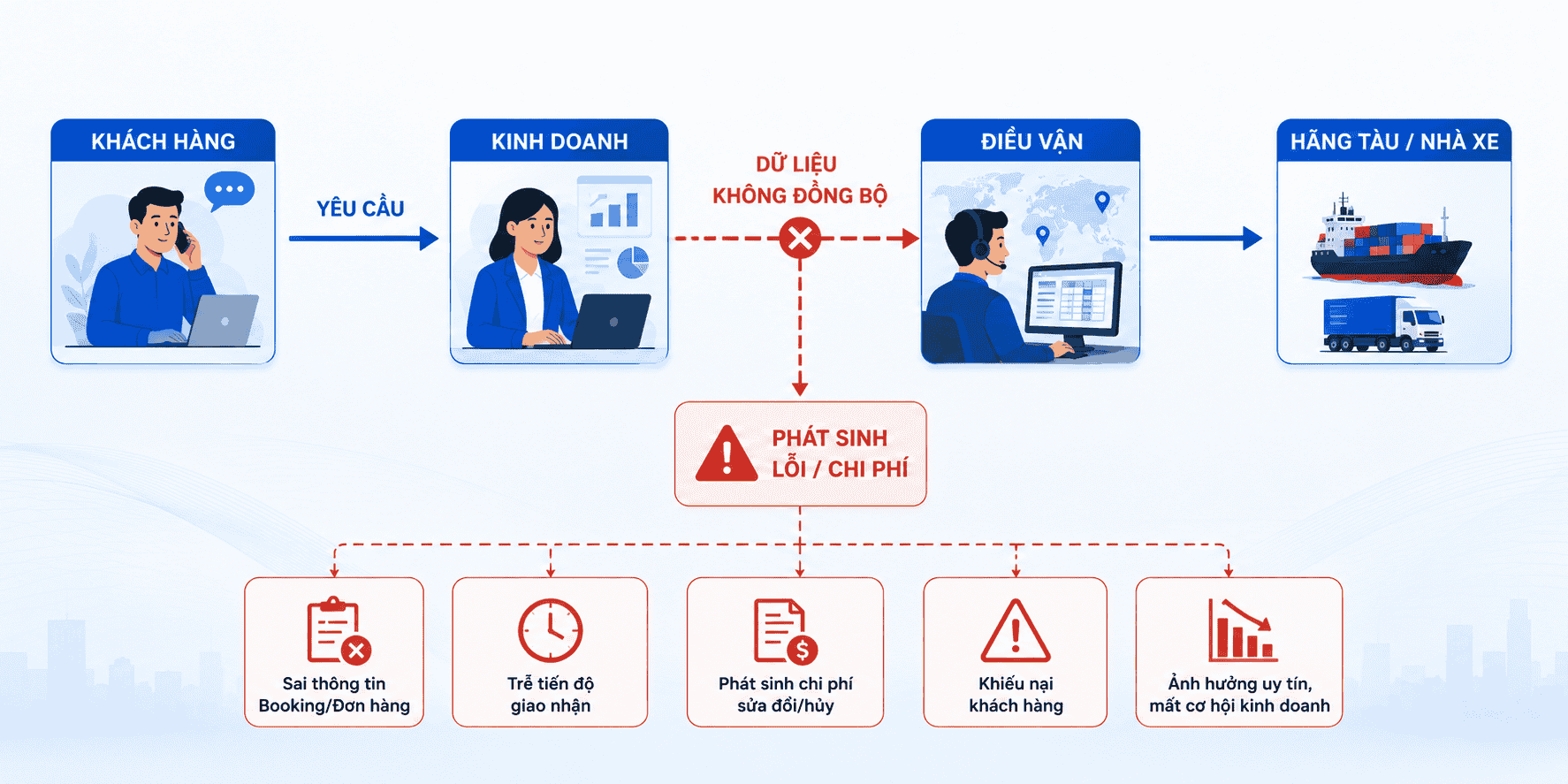
2. Four root causes of data discrepancy between sales and operations
Cause 1: Fragmented tools and manual communication
Most data conflicts originate from traditional communication methods. Sales teams often record order information via Zalo, email, or personal Excel spreadsheets. Once an order is confirmed, this data is transferred to operations by re-entering it manually or sending attachments.
This manual handover process creates significant risks:
- Data entry errors: Incorrectly entering quantities, packaging specifications, or delivery locations.
- Lost data: Special customer requests (e.g., crane requirements or temperature-controlled cargo) get lost in messaging threads hundreds of lines long.
- Inconsistent data versions: Sales updates prices in an Excel file on their personal computer without syncing it with the file operations is using to register with shipping lines.
Cause 2: Lags in updating cost and freight fluctuations
The logistics market fluctuates daily, even hourly. Ocean freight rates, bunker adjustment factors (BAF), currency adjustment factors (CAF), and inland trucking rates change constantly.
When sales sends a quote based on an outdated rate card that operations has not updated, or when operations accepts additional supplier surcharges without notifying sales in time to bill the customer, conflict is inevitable. At this point, the question "Who is responsible for this cost difference?" triggers internal disputes.
Cause 3: Lack of standardized order data structures
Sales tends to record information using customer phrasing, which is often qualitative and lacks technical details. Conversely, operations requires structured data to work with shipping lines, customs authorities, and local transport providers.
For example: Sales records a shipment as "1 container of electronic components." However, when operations receives it, they need to know whether it is a 20DC, 40HC, or 45RF container, the exact gross weight, and whether it contains lithium batteries (dangerous goods - DG). This lack of standardized input data forces operations to spend valuable time re-verifying details, delaying delivery schedules and frustrating both sides.

Cause 4: Lack of real-time order visibility
Throughout cargo transit, customers constantly request status updates: Has the shipment cleared customs? Did the vessel depart on time? When will the goods arrive at the warehouse?
Without a centralized tracking system, sales is forced to call or message operations for updates. Operations then has to check with truckers, shipping lines, or agents. This multi-tiered communication chain wastes time and creates significant information lags. By the time data reaches sales, the actual status of the shipment has changed, leading to inaccurate updates provided to customers.
3. Consequences on operational efficiency and profit margins
Data conflicts do not end with daily internal disputes; they directly cause measurable losses in finance and company reputation:
Consequence | Real-world manifestation | Financial & management impact |
Profit leakage | Omitting surcharges and failing to bill customers; compensating for demurrage/detention costs due to documentation delays. | Directly reduces profit margins on each shipment. |
Declining customer experience | Inaccurate quotations, unrealistic schedule commitments, slow incident response. | Customers switch to other logistics providers. |
Wasted operational resources | Staff spend 30–40% of their time cross-checking information and making verification calls. | Increases labor costs and reduces order processing productivity. |
Cash flow risks | The accounting department cannot issue invoices because sales and operations data are not aligned. | Delays debt collection, impacting overall company cash flow. |
4. Solution: Building a centralized data ecosystem
To fundamentally resolve data conflicts, logistics business owners cannot rely solely on asking staff to "strengthen collaboration" or "improve work attitudes." The core of the problem demands a structural solution: standardizing processes and automating data workflows on a single source of truth platform.
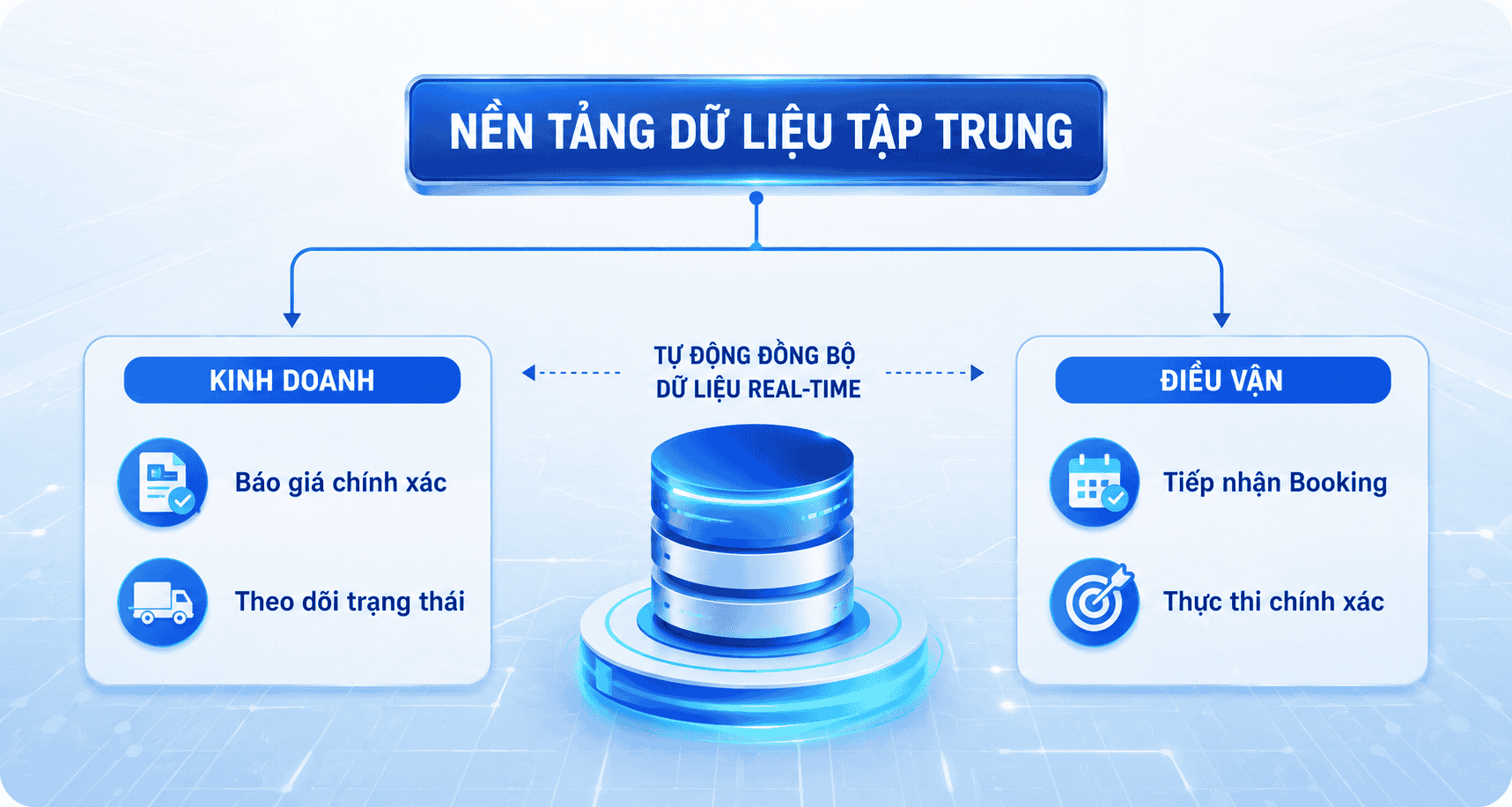
Applying technology to digitize operational processes completely eliminates manual data bottlenecks:
- Instant standardization of input data: When sales creates a quotation request or books an order on the system, mandatory fields regarding cargo specifications, delivery terms (Incoterms), and routes are fixed. Operations receives complete data without needing to re-verify.
- Real-time actual cost updates: All expenses incurred during operations (customs inspection fees, lift-on/lift-off fees, additional freight charges) are recorded directly into the system. Sales and accounting immediately see profit fluctuations for each shipment to take timely action.
- Enhanced visibility: Both sales and operations view a single order status dashboard. Sales proactively tracks cargo locations to inform customers without interfering with or distracting operations from their core tasks.
In the digital transformation trend of the freight forwarding industry, adopting specialized software like Sota FMS helps businesses seamlessly connect data flows from quotation and booking to customs documentation management and cost settlement. When information flows automatically and transparently, human error risks are minimized, establishing a solid foundation for companies to optimize performance and scale up business operations.
Conclusion
Data conflicts between sales and operations are not a human resources issue, but a matter of corporate data management capability. In a logistics market with increasingly fierce competition on price and service quality, companies that control accurate and seamless data flows will hold the advantage in optimizing costs and retaining customers.
It is time for executives to move beyond manual management models relying on Excel or fragmented messaging, toward building a centralized data system—where sales and operations align on a single direction and operate on a single source of truth.