Every minute a vehicle sits idle without cause, every route deviation, or every undetected delivery incident directly erodes a transport company's profit margins. For logistics executives, failing to pinpoint precise cargo status and location in real time creates dangerous "information blind spots" across the supply chain. End-of-day periodic reports and manual verification phone calls can no longer keep up with the market's relentless operational speed.
In modern transportation management ecosystems, real-time order tracking is no longer an optional add-on, but a core capability that determines operational efficiency, brand credibility, and business scalability.
The essence of real-time order tracking in transportation management
Concept and data integration mechanism
Real-time order tracking in transportation management software (TMS) is the ability to collect, process, and display the operational data stream of each order continuously in real time, from creation, loading, and transit, to final delivery at the destination.
Many businesses confuse basic vehicle tracking with real-time order tracking. In reality, GPS tracking only provides the geographical coordinates of the tractor unit or truck. In contrast, real-time order tracking is a multidimensional integration of:
- Spatial data: GPS coordinates, speed, and vehicle route.
- Status data: Packed, loading, in transit, en-route incident, arrived at destination, and completed ePOD confirmation.
- Temporal data: Estimated time of arrival (ETA) automatically calculated based on traffic density and actual speed.
The difference between traditional tracking and real-time models
In traditional transportation models, information flow relies entirely on manual reports via phone calls, messaging apps, or Excel spreadsheets. This approach suffers from two major flaws: high information latency and inaccuracy due to human subjectivity. When issues such as traffic congestion, vehicle breakdowns, or cargo quantity disputes at delivery points occur, management typically receives information only after the consequences have already unfolded.
In contrast, a real-time order tracking system establishes an automated, continuous, and transparent data flow between three key parties: dispatchers, drivers, and cargo owners. Any route fluctuation is immediately recorded and alerted by the system, enabling management to transition from "reactive troubleshooting" to "proactive risk management.
4 strategic values of real-time tracking capabilities for businesses
1. Cutting hidden costs and optimizing operational expenses
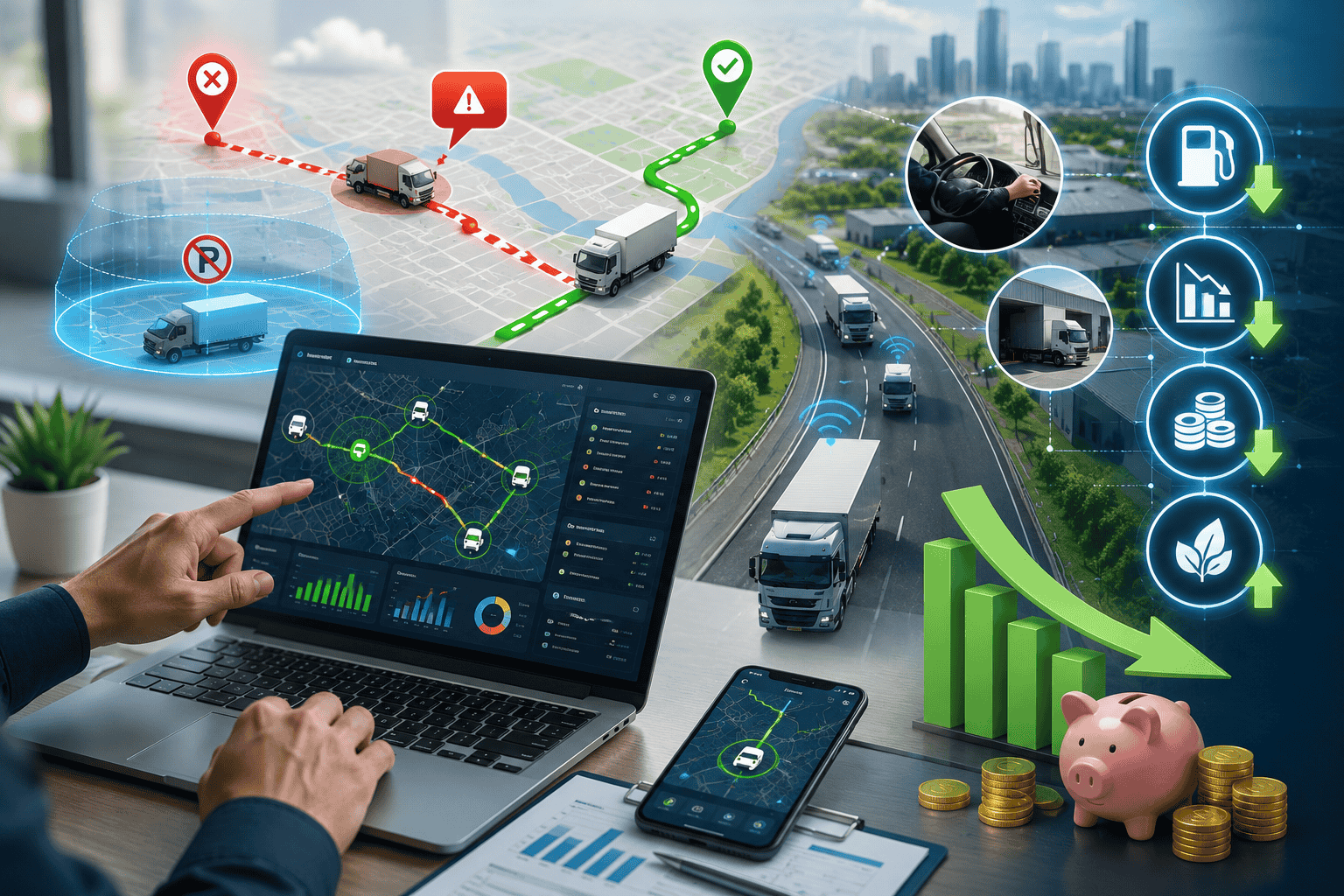
Transportation costs include not only fuel and tolls, but also numerous hidden costs arising from a lack of control. Without real-time tracking tools, risks such as drivers deviating from prescribed routes, unauthorized stops, or prolonged idling with air conditioning directly increase fuel consumption and asset wear.
Real-time tracking systems enable geofencing alerts and route deviation monitoring. When a vehicle strays from the optimal route or stops beyond the allowed duration, the system automatically triggers an alert. This tight control helps businesses minimize fuel loss, eliminate empty miles, and optimize costs per kilometer.
2. Improving SLA compliance and B2B customer experience
For B2B partners and cargo owners, delivery reliability (On-Time In-Full - OTIF) is the top criterion for evaluating the capabilities of logistics service providers (3PL/4PL). Delivery delays not only lead to contractual penalties but also disrupt the customer's production chain.
Through real-time order tracking, businesses can provide customers with a self-service portal or a direct tracking link. Customers can proactively track the exact shipment location and estimated time of arrival (ETA) without having to contact call centers or dispatchers. This not only enhances service professionalism and transparency, but also helps customer service teams reduce up to 70-80% of time spent answering order status inquiries.

3. Maximizing fleet utilization and dispatch efficiency
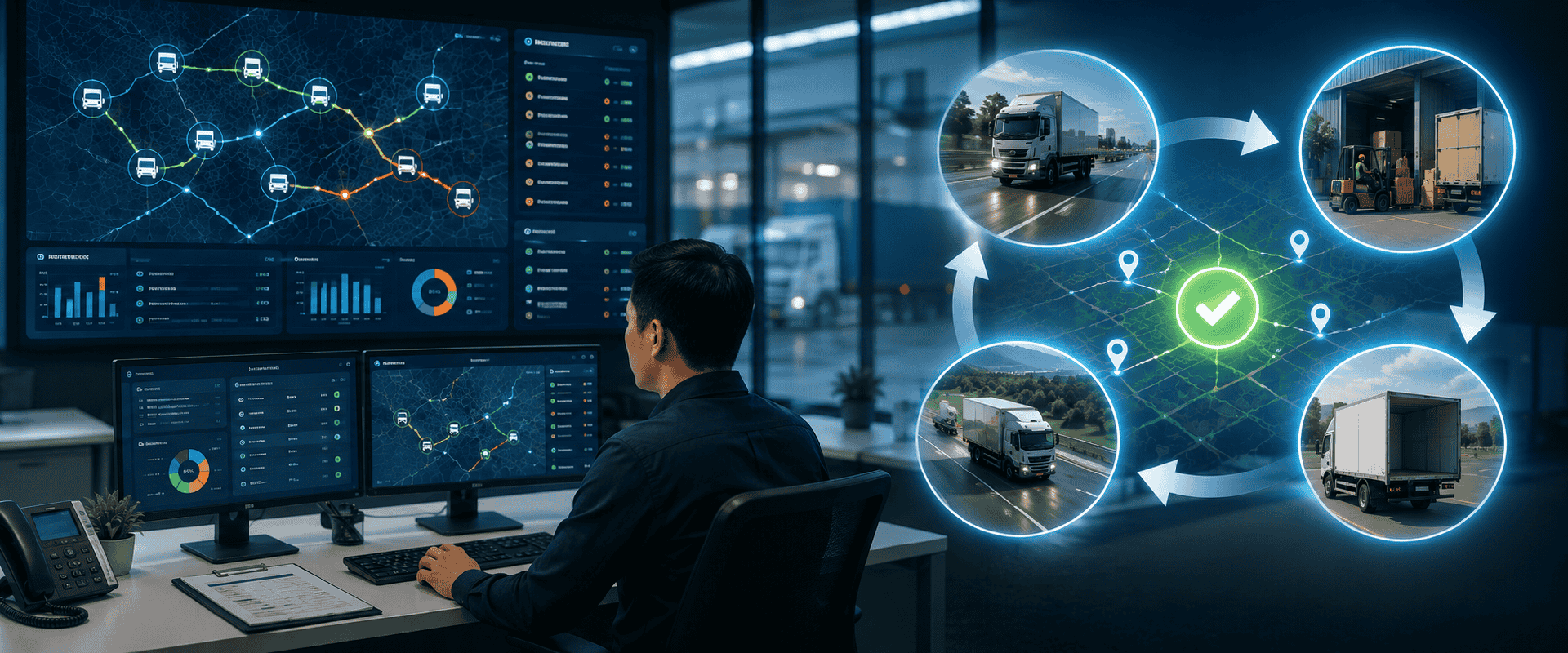
One of the greatest challenges for transport companies is asset utilization. Due to a lack of real-time data, dispatch teams often struggle to assign the next trip to vehicles that are about to complete their current route.
With the centralized monitoring dashboard of a TMS, dispatchers gain a complete view of fleet status: which vehicles are moving, which are unloading, and which are becoming available soon. Real-time data helps shorten turnaround time, optimize scheduling, and increase daily vehicle trips without investing in new fleet additions.
4. Digitizing risk management and proof of delivery (ePOD)
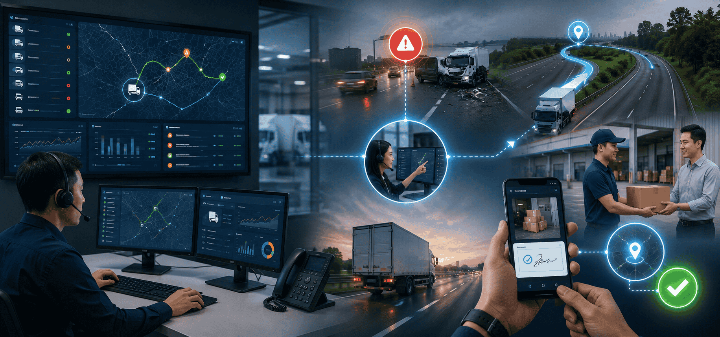
En-route incidents are inevitable in the transport industry. The value of a real-time tracking system lies in its exception management capabilities. When collisions, breakdowns, or severe traffic jams occur, the system immediately sends notifications to the control center. Dispatchers can proactively reroute alternative vehicles or notify cargo owners in advance to adjust receiving plans.
Additionally, combining real-time tracking with electronic proof of delivery (ePOD) allows drivers to upload cargo photos, customer signatures, and delivery coordinates immediately upon completion. This instant verification data shortens payment reconciliation cycles and minimizes potential commercial disputes.
Key standards of real-time tracking features in modern TMS software
To maximize the practical value of real-time order tracking, modern transportation software must meet the following technical and operational standards:
- Low latency: Location and status data must be updated in cycles of seconds or minutes to accurately reflect conditions on the ground.
- Multi-device integration: Flexible integration of data from multiple sources, such as vehicle GPS black boxes, journey monitoring devices, temperature and door sensors (for cold chain cargo), and dedicated driver mobile apps.
- Smart alerts: Automatically categorizing and sending alerts based on preset risk scenarios (speeding, prolonged stops, route deviations, unauthorized cargo door opening).
- Multi-level access control: Configurable information displays tailored to each role: executive management (high-level reports), dispatchers (technical details), drivers (trip assignments), and customers (waybill status).
Practical application of real-time tracking with Sota TMS
In the roadmap to modernizing transportation processes, choosing a TMS platform with powerful real-time tracking capabilities is a decisive step for logistics enterprises and fleet owners.
The Sota TMS transportation management system was developed to thoroughly resolve information gaps during the delivery process. Deeply integrating real-time waybill status tracking, Sota TMS provides managers with an intuitive and comprehensive digital Control Tower.
- Closed-loop journey control: Sota TMS seamlessly connects every stage from order reception, automated trip consolidation planning, and vehicle dispatch, through to successful delivery at the destination. The status of each order is continuously updated according to standardized event milestones.
- Optimized monitoring capabilities: Thanks to flexible integration with GPS systems and driver mobile applications, Sota TMS helps businesses proactively control precise vehicle positions and travel speeds while receiving instant alerts on operational bottlenecks.
- Data transparency for customers: Sota TMS provides automated order status sharing tools, helping business owners standardize customer service quality and enhance competitiveness when bidding for major logistics projects.
Strategic advice for executives investing in tracking technology
Implementing real-time order tracking is not merely purchasing a software tool; it is a process of restructuring the operational mindset across the entire organization. To maximize return on investment (ROI), business owners should consider the following key factors:
- Shifting to data-driven management: Transition completely from relying on personal experience to making decisions based on specific, quantified real-time data.
- Standardizing processes before digitizing: Clearly define standard order status milestones tailored to the business model before configuring them in the software.
- Aligning operational capabilities: Conduct structured training for dispatchers and drivers. Driver compliance in updating statuses via the mobile app is the deciding factor in the accuracy of the entire tracking data stream.
Conclusion
In an increasingly competitive transportation market, the speed and transparency of information serve as the true measure of a company's operational capability. Real-time order tracking does not merely reduce costs, eliminate risks, and boost fleet productivity—it also builds strategic trust with clients.
Selecting and deploying a professional TMS platform equipped with real-time status tracking capabilities—such as Sota TMS—is a foundational investment. It enables transportation enterprises to master their data, optimize resources, and confidently achieve breakthroughs on their path to sustainable growth.