At month-end close, the management of a freight forwarding company typically has total revenue and bank balances on hand within hours. Yet questions such as which shipments were profitable, which incurred losses, which customers have overdue balances, and which surcharges were never recovered often take days to answer, because the data must be compiled from each department's Excel files. The cause is not a lack of staff capability but the way data is stored across disconnected sources. ERP for logistics (enterprise resource planning) is designed to address exactly this problem. This article examines five management problems that logistics companies can solve with ERP.
Why logistics companies need tighter internal management
According to BIDV Research, logistics costs in Vietnam stand at around 16.5% of GDP, compared with a global average of 11.6%. The draft National Logistics Services Development Strategy for 2025–2035 targets digital transformation for 80% of logistics enterprises and a reduction of logistics costs to 12–15% of GDP. A Vietnam Report survey found that in the first three quarters of 2025, revenue rose for most logistics companies, but profitability diverged sharply as costs climbed.
Higher revenue does not necessarily mean higher profit. The ability to track costs and margins accurately at the individual shipment level is therefore a basic management requirement, and a sound basis for treating ERP as an investment worth serious consideration.
Problem 1: Determining the true profitability of each shipment
Most freight forwarders operate in a high-volume, low-margin environment, so missing even a small operating charge can distort business results. When accounting is separated from the operations system, incurred costs such as handling fees, storage fees, and documentation charges are often not fully recorded.
ERP links each job to its corresponding financial transactions. Management can view profit and loss by shipment, customer, trade lane, or branch. With ERP, profit and loss reports are calculated in real time for each shipment and each sales representative, with commissions calculated automatically.

Problem 2: Unifying data across sales, operations, documentation, and accounting
Every shipment generates quotations, bookings, transport documents, customs information, supplier costs, customer invoices, and accounting entries. When this data sits across multiple systems, spreadsheets, and email, departments must re-enter the same information. Repeated data entry increases the risk of errors and lengthens processing times.
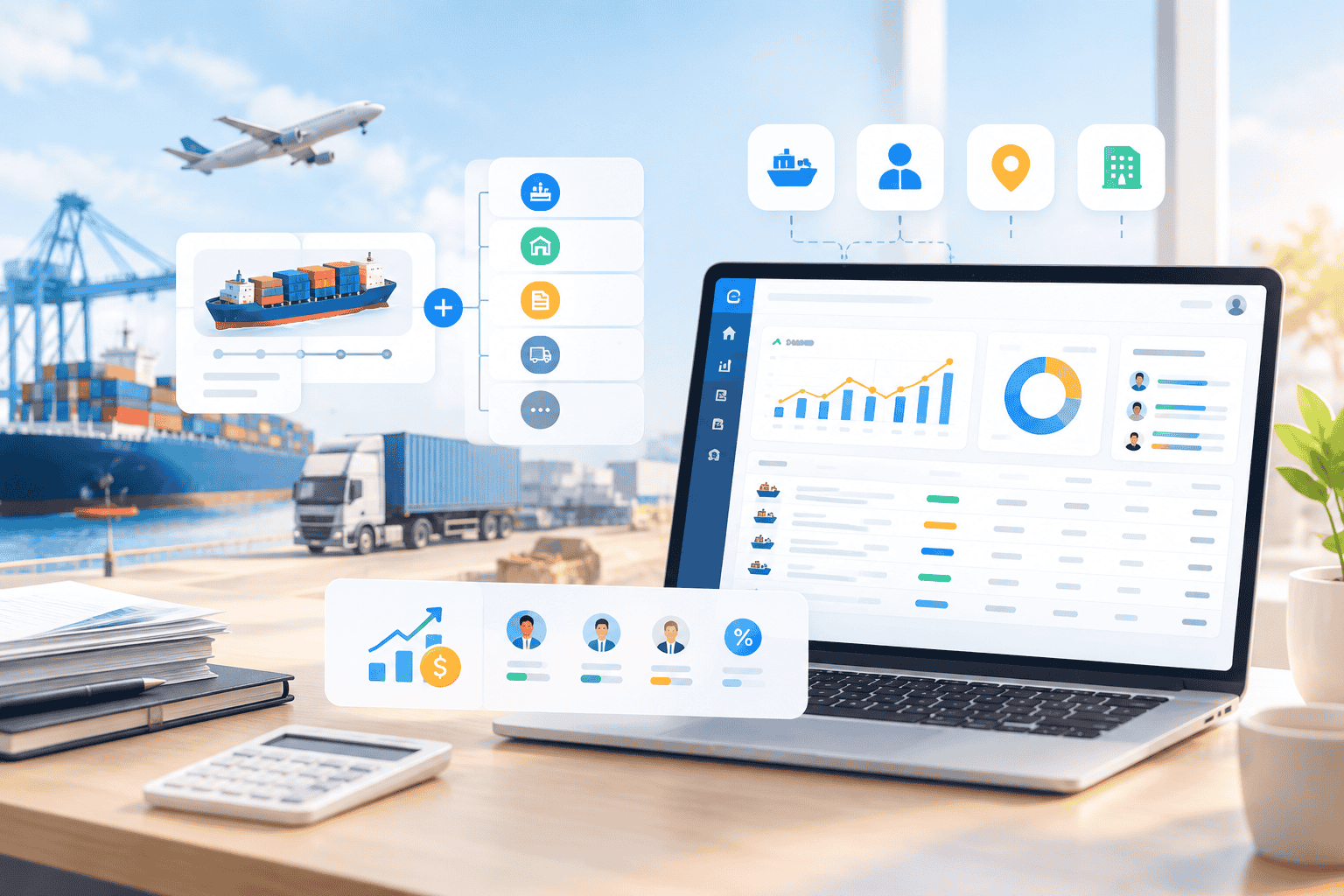
ERP for logistics consolidates financial, customer, fleet, and cargo information into a single database, removing data silos between departments. According to figures compiled by several implementation providers in Vietnam, the time operations staff spend on manual tasks can fall by as much as half compared with working entirely in Excel.
Sota FMS is built on this approach: sales, operations, documentation, and accounting work on one system. An AI-powered OCR function reads bookings and pre-fills job information, reducing initial data entry.
Problem 3: Managing quotations and multi-layer pricing
Freight forwarders work with many shipping lines, airlines, and agents, each with its own rates, routes, and validity periods. A sound process keeps buying rates, selling rates, minimum charges, and surcharges consolidated in one place. If rate sheets are scattered across emails and personal files, quotations are prone to inconsistency and comparing suppliers takes considerable time.
Sota FMS manages three pricing layers: the buying rate from suppliers, the internal rate, and the selling price to customers. Sales staff see only the rates assigned to them, not actual vendor costs. When preparing a quotation, the system immediately displays the expected profit and allows the quotation to be converted into a booking without re-entering data.
Problem 4: Controlling receivables, payables, and cash flow
Freight forwarders often pay carriers in advance while customers pay later. With manual tracking, overdue receivables and upcoming payables are difficult to reconcile in time, which increases financial risk.
Accounting modules need to support accruals, multi-currency handling, customer credit control, and job-level cost accounting. With Sota FMS, multi-currency debit notes and credit notes are generated automatically from a job or House B/L, then passed directly to accounting for invoicing and ledger posting. The system also supports VAT, e-invoicing, banking, and payroll, and maintains a complete audit log to support reconciliation.
Problem 5: Scaling the business without depending on individual experience
Many companies operate on the experience of a few key personnel. This approach works at a small scale but is difficult to replicate as the company adds branches, hires more staff, or moves to remote work.
ERP standardizes processes and assigns permissions by role. A good freight management system allows workload to grow without a proportional increase in headcount. According to its developer, Sota FMS can raise the level of automation by up to 65% and cut wasted operating time by up to 60%. Several companies that have implemented it, such as LTU Vietnam and FTF, moved from Excel to an online system so that management can monitor business and operational performance in real time.

Criteria for selecting an ERP for logistics companies
Before implementation, business owners should evaluate four areas:
- Industry specificity: whether the system natively supports Job, House B/L, Master B/L, E-Manifest, and debit/credit note workflows.
- Accounting and compliance: whether the system integrates accounting, tax, and e-invoicing in line with Vietnamese regulations.
- Initial data: legacy data on customers, rate sheets, and historical shipments must be cleaned, validated, and migrated carefully, otherwise implementation quality will suffer.
- Scalability: whether CRM, project management, and API integrations can be added without changing platforms.
Sota FMS is an ERP built specifically for logistics and freight forwarding companies and meets the criteria above. The system covers the full chain of operations, from CRM, quotation, booking, and job management to documentation, accounting, receivables and payables, and reporting, on a single platform. It is suitable for businesses ranging from small and medium-sized enterprises to large corporations.
Conclusion
The five problems above share one root cause: operational, commercial, and financial data are not connected. When data is unified, business owners have a sound basis for pricing, selecting customers, controlling costs, and deciding on expansion. Companies still relying on Excel or multiple disconnected tools should begin by reviewing their current processes, identifying the most pressing problem, and then selecting a suitable solution. To see the system in operation, you may register for a trial or request a consultation on Sota FMS.