A shipment has been delivered and the customer has paid in full. The question for management is how much profit that shipment actually generated after freight charges, surcharges, incidental costs and sales commissions. At many logistics companies, the answer only emerges after several days of manual reconciliation between sales, operations and accounting. This delay does not stem from staff capability. The cause is data held in disconnected systems, which means the company lacks an ERP system with the right modules.
The pressure to improve is growing. Logistics costs in Vietnam remain at around 16% of GDP, while the 2025–2035 strategy sets a target of reducing them to 12–15%. Decision No. 2229/QD-TTg also sets a goal of 80% of logistics enterprises adopting digital transformation. This article identifies the ERP modules that logistics companies must have, giving business owners a sound basis for evaluating solutions before investing.
Why generic ERP does not fit the logistics industry
Standard ERP is designed around the purchasing, sales, inventory and accounting cycle of manufacturing and trading companies. Logistics companies, particularly freight forwarders, operate on a different logic. They sell services rather than goods. Revenue and costs arise shipment by shipment. A single Master B/L may cover multiple House B/Ls. Freight rates vary by route, carrier and validity period.
An analysis of freight forwarding applications built on open-source ERP shows that generic ERP cores typically have no concept of a freight job, a house bill matched to a master bill, or tariffs calculated per TEU, kilogram or volume, so operations are forced back onto spreadsheets and email. An academic study of ERP in logistics enterprises found the strongest positive impact in transport management, documentation and accounting. Therefore, the first criterion when selecting an ERP is the degree of industry-specific support, not the number of modules.

7 essential ERP modules for logistics companies
1. CRM and sales team management module
This module manages sales opportunities, customer care history and the KPIs of each sales representative. For logistics, the CRM must capture industry-specific information such as cargo volume, port of loading (POL) and port of discharge (POD). Generic CRMs often lack these fields, leaving customer data fragmented and operational information incomplete. CRM data should connect directly to quotation and booking to avoid duplicate data entry.
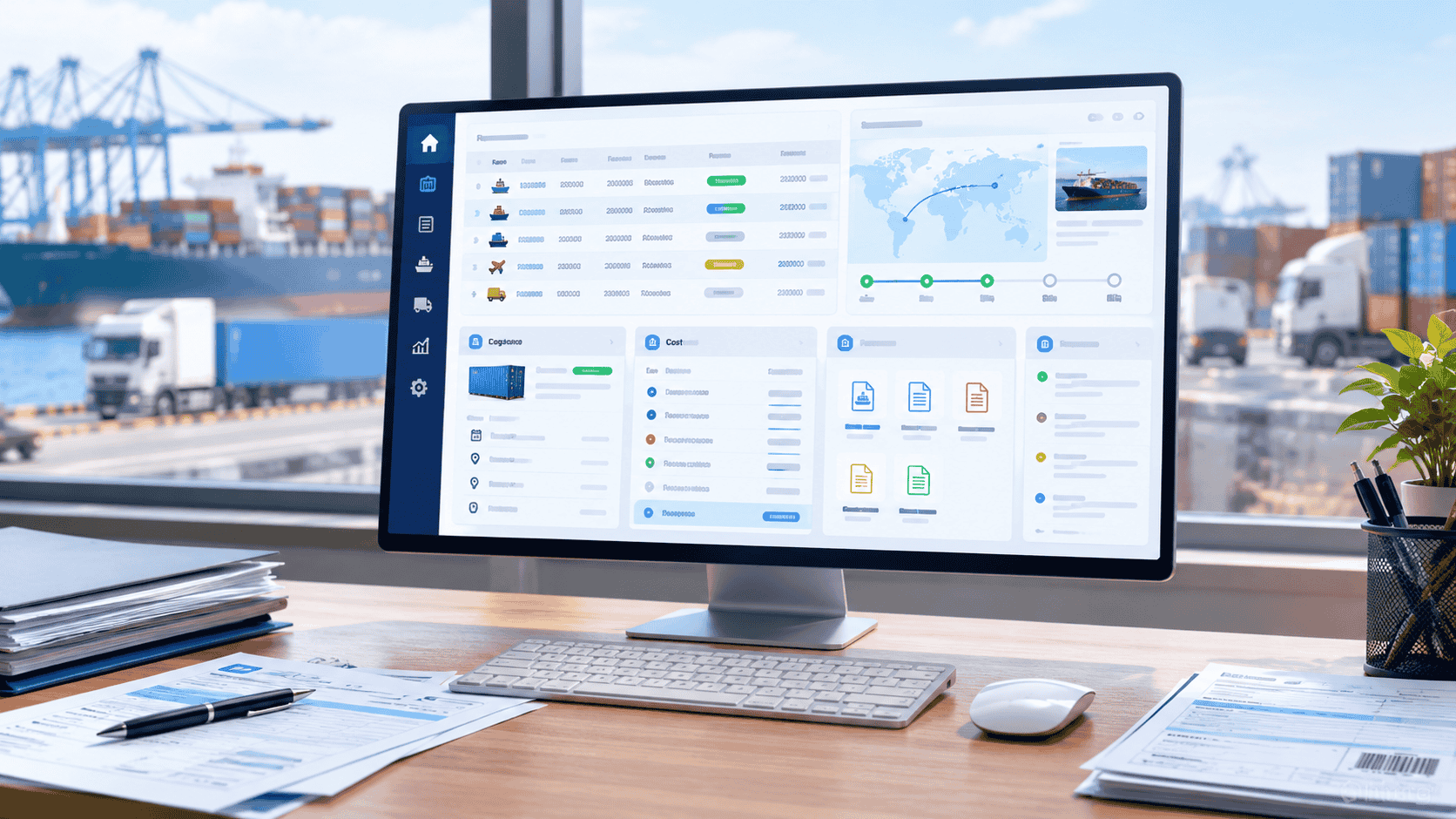
2. Pricing and quotation management module
Buying rates from shipping lines, airlines and agents change constantly. This module centralizes rates from multiple suppliers by route, POL/POD, charge type and validity period. Sales teams can compare buying and selling prices and preview a shipment’s profitability at the moment a quotation is created. The goal is to eliminate quotations based on expired rate sheets or quotations with negative margins.
3. Booking (Order) management module
A booking should be created directly or converted from a quotation the customer has accepted, together with customer details and internal operational information. The system must support sending booking confirmations by email and allow customers to check order status themselves, reducing the manual follow-up workload of the customer service team.
4. Job and bill of lading management module
This is the core module. The job is the central management unit, linking the documents, costs, revenue and profit of each shipment. The module needs to manage House B/Ls, Master B/Ls, manifests, invoices, packing lists, certificates of origin (C/O), arrival notices and delivery orders, while automatically linking these documents to the job.
This is the core module. The job is the central management unit, linking the documents, costs, revenue and profit of each shipment. The module needs to manage House B/Ls, Master B/Ls, manifests, invoices, packing lists, certificates of origin (C/O), arrival notices and delivery orders, while automatically linking these documents to the job.
5. Debit Note, Credit Note and receivables management module
A freight forwarder’s revenue is recorded through debit notes and credit notes issued per shipment, often in multiple currencies. The module should automatically generate these documents from the job, centrally manage receivables and payables, and keep a log of sending and edits. Manual tracking and slow collection increase cash flow risk, so this module bears directly on the company’s liquidity.
6. Financial accounting module
Accounting must be integrated with the operations module and not run independently. When a debit note is confirmed, the corresponding invoice and journal entries must be created automatically. The module should cover cash, banking, VAT, e-invoicing, payroll and financial reporting in line with current regulations. Automatic reconciliation between the books and operational transactions reduces discrepancies at period-end closing.
7. Management reporting module
Business owners need real-time reports on profit and loss by shipment, customer, sales representative and trade lane. These should also include sales against KPIs and receivables by aging. Sales commissions should be calculated automatically from the actual profit of each shipment. This module directly supports decisions on pricing, customers and resource allocation.
Depending on the business model, companies may add extension modules such as warehouse management (WMS) or domestic transport management (TMS). The seven modules above are the indispensable foundation.

Sota FMS: An ERP purpose-built for the logistics industry
Sota FMS is developed by Sota Solutions specifically for freight forwarding and logistics companies. The solution covers the entire chain of operations described above in one unified system: CRM, quotation, booking, job, bill of lading, debit/credit note, accounting and reporting. Its specialized features include:
- Three-layer pricing management (Buying – Buying Rate – Selling): separates supplier rates, internal rates and customer selling prices, ensuring price confidentiality so that sales staff see only the rates assigned to them.
- Automatic cost allocation from the Master Bill to House Bills by volume (sea freight) or chargeable weight (air freight).
- AI OCR that automatically reads bookings, extracts data and populates job information.
- Real-time profit and loss reporting by shipment and by sales representative, with automatic commission calculation.
- Customizable print templates for HBL, HBL Origin and E-Manifest, and multi-currency Debit/Credit Notes linked to shipments.
ccording to Sota, the system raises automation by up to 65% and cuts up to 60% of wasted operational time. Sota FMS has been deployed at businesses including LTU Vietnam, FTF and Leopard, mainly replacing Excel-based and fragmented systems. Businesses can view details on the Sota FMS solution page, try the system, or book a demo.
Criteria for evaluating an ERP solution for logistics
Once the necessary modules have been identified, business owners need a consistent set of criteria to compare the solutions on the market. The six criteria below focus on the factors that determine real-world effectiveness.
- Degree of industry specialization. The system must natively support jobs, House B/Ls, Master B/Ls, consolidated cost allocation and route-based tariffs. If these operations require heavy customization from the start, implementation costs and trial-operation time will increase significantly.
- Integration between operations and accounting. Data from the job must flow into debit/credit notes, invoices and ledgers without re-entry. A single source of data is the precondition for shipment-level profit figures to match the accounting figures.
- Permissions for cost and profit data. Companies need role-based permissions so that sales, operations and accounting staff access only their own scope of information. Supplier cost data is sensitive and must be protected within the system itself.
- Compliance with Vietnamese regulations and market conditions. The system must meet current requirements for e-invoicing, VAT, accounting standards and document templates. Solutions designed for other markets are often incompatible with local regulations, forcing branches back to manual work.
- Cloud platform, scalability and API connectivity. The system should be accessible remotely, scale with the number of users and connect to other platforms through APIs. Experts recommend phased implementation and prioritizing cloud-based solutions to reduce costs.
- Training and post-implementation support. Many digital transformation projects fail to deliver results because staff do not use the system correctly. Companies should require vendors to commit clearly to training, technical support and response times after the system goes live.
Conclusion
The seven modules above form a continuous data chain from sales opportunity to the actual profit of each shipment. With any link missing, a company will continue to depend on manual reconciliation and slow decision-making. Business owners should evaluate ERP solutions on their degree of specialization for logistics. To see the system operate with your company’s actual data register for a consultation and a Sota FMS demo..