In the context of increasingly complex global supply chains and intensifying pressure for faster delivery, transport management is no longer just about coordinating vehicles and drivers. For transport enterprises in Vietnam, competition no longer rests solely on freight rates but on the ability to optimize processes and ensure data transparency. This is precisely where a Transportation Management System (TMS) asserts its role as a core technological foundation.
So, what exactly is a TMS? How does it function, and what tangible value does it bring to a company's bottom line? This article will provide a comprehensive breakdown from A to Z.
What is TMS?
A Transportation Management System (TMS) is a specialized software solution designed to support the planning, execution, optimization, and monitoring of all freight transport operations. A TMS facilitates the management of both domestic and international shipping across various modes, including road, sea, air, and multimodal transport.
Unlike a Warehouse Management System (WMS), which focuses on internal facility operations, a TMS is dedicated to "goods in transit"—managing the movement of cargo from its point of origin to its final destination. To ensure a seamless and unified data flow, these systems typically integrate with ERP (Enterprise Resource Planning), WMS, and other SCM (Supply Chain Management) platforms.
There are two primary deployment models for a TMS:
- On-premise: Installed directly on the enterprise’s local servers; this model is ideal for organizations with stringent data security and sovereignty requirements.
- Cloud-based (SaaS): The prevailing choice today, favored for its high scalability, low upfront investment, and automatic system updates.
In Vietnam, TMS adoption is accelerating among logistics providers, manufacturers, and trading firms as they navigate fuel price volatility, increasing demands for rapid delivery, and intensifying market competition.

The role of TMS in the logistics supply chain
A TMS serves as the central operational hub for transportation, seamlessly connecting key stakeholders, including shippers, carriers, warehouses, and end customers. The system facilitates:
- Optimization of transport resources: Maximizing fleet utility and reducing empty miles.
- Regulatory compliance: Ensuring adherence to legal requirements, such as e-invoicing and customs documentation.
- Real-time data visibility: Providing actionable insights for rapid and informed decision-making.
In modern logistics environments—where transportation often accounts for a major portion of total supply chain costs—a TMS enables businesses to transition from manual workflows to intelligent automation. This shift not only minimizes operational risks but also significantly enhances forecasting and predictive capabilities.
Why do logistics enterprises need a TMS right now?
Fluctuating fuel prices, skilled labor shortages, and stringent emission standards (Green Logistics) are placing immense pressure on businesses. Relying on manual management through Excel or fragmented tools has revealed significant bottlenecks:
- Lack of Visibility: Without real-time tracking of vehicle locations or cargo status, businesses remain reactive rather than proactive when disruptions occur.
- High Operational Costs: Failure to optimize vehicle loads—specifically the issue of empty backhauls—and inefficient routing leads to excessive fuel wastage and increased overheads.
- Inaccurate Data Reconciliation: Managing invoices and transport documents manually often results in discrepancies during payment processing and tax settlements.
Adopting a TMS is no longer just a trend; it is a strategic imperative for digitalizing operations. It allows businesses to minimize their dependency on manual tasks and shift their focus toward high-level strategic decision-making.

Key features of a Transportation Management System (TMS)
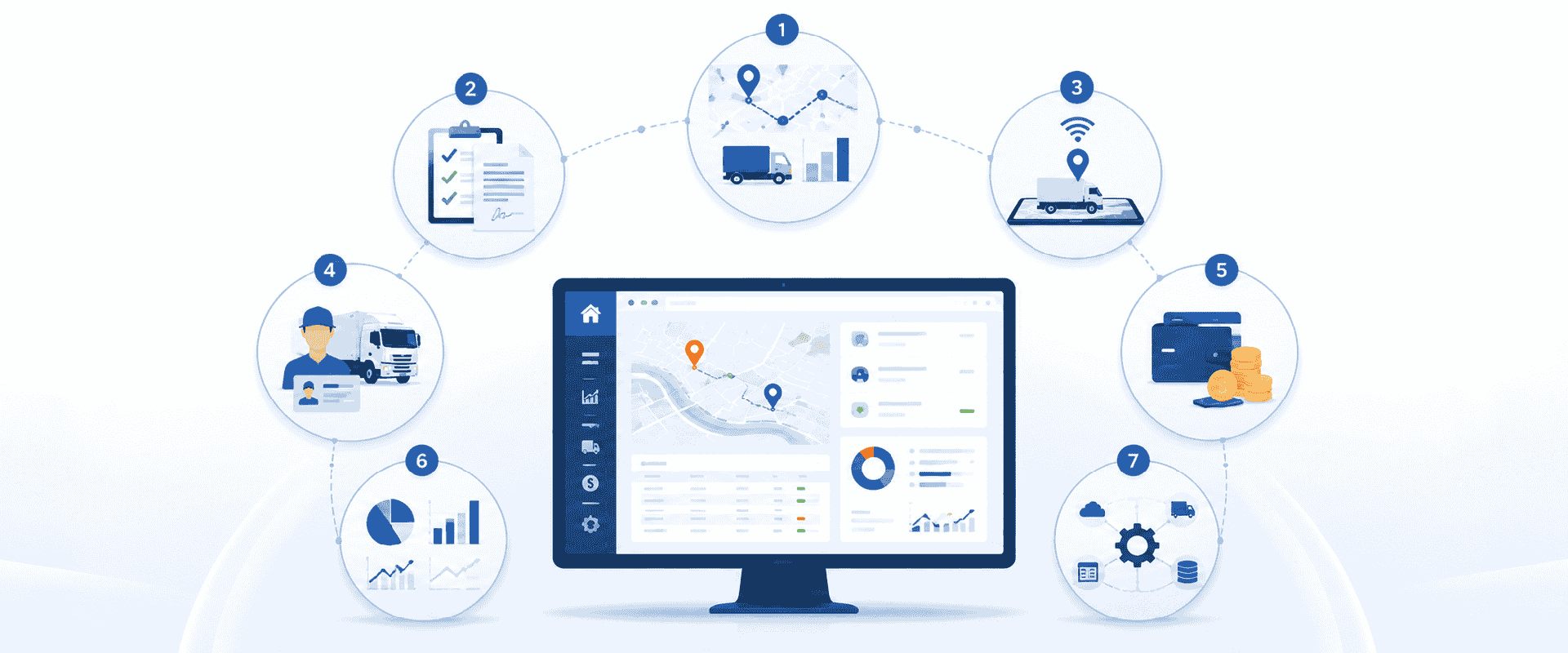
A professional TMS typically consists of the following core modules:
1. Transport planning and optimization
The system automatically analyzes order data, locations, cargo types, volumes, and time constraints to recommend optimal routes, vehicles, and carriers. Optimization algorithms help reduce travel distances, facilitate shipment consolidation, and select the most appropriate transport mode (road, sea, air).
2. Bill of Lading (BOL) and E-Document management
Automatically generate, manage, and store BOLs, invoices, and customs documentation. Integration with digital signatures and e-invoicing reduces manual paperwork, minimizes human error, and ensures full compliance with regulations from the Ministry of Industry and Trade (MOIT) and the General Department of Vietnam Customs.
3. Real-time visibility and monitoring
By integrating GPS, IoT, and specialized sensors, the system tracks location, temperature (for cold chain logistics), and cargo status in real-time. Both businesses and customers can access centralized dashboards to monitor progress and receive instant alerts regarding any disruptions.
4. Fleet and driver management
Monitors vehicle health, maintenance schedules, driver performance, and service hours. This module supports automated task assignment and comprehensive performance evaluations (KPI tracking) for the driving team.
5. Cost management and settlement
Provides a granular analysis of costs, including fuel, tolls, demurrage, and freight rates. It automates invoice reconciliation and freight auditing to detect billing discrepancies and provide data-driven leverage for negotiating better rates with service providers.
6. Analytics and business intelligence (BI)
Delivers critical KPIs such as On-Time Delivery (OTD) rates, cost-per-order, vehicle utilization, and transit cycle times. These insights support accurate demand forecasting and advanced scenario simulation for strategic planning.
7. Integration and automation
Seamlessly connects with ERP, WMS, CRM, e-commerce platforms, and partner carrier systems. The leverage of AI/ML (Artificial Intelligence/Machine Learning) enables predictive analytics and dynamic route optimization to adapt to changing conditions.
Superior benefits of implementing a TMS
When effectively deployed, a TMS delivers tangible and quantifiable value to an enterprise:
- 10–25% Reduction in Transportation Costs: Achieved through advanced route optimization and enhanced fleet productivity management.
- Boosted Workforce Productivity: Automating repetitive, manual tasks allows dispatch and logistics teams to focus on managing complex orders and high-value exceptions.
- Strengthened Customer Trust: Providing accurate Estimated Time of Arrival (ETA) updates fosters transparency, building long-term brand reputation and customer loyalty.
- Data-Driven Decision Support: Eliminates subjective management and guesswork by providing concrete, real-time metrics on overall business performance.
Key TMS technology trends in 2026
The year 2026 marks a significant technological leap in the logistics industry. A modern TMS is now defined by its integration of the following transformative trends:
- Artificial Intelligence (AI): AI is now leveraged to proactively predict risks related to weather and traffic conditions. This allows the system to recommend automated contingency plans and alternative routes before disruptions can impact the supply chain.
- Green Logistics: Modern TMS platforms now feature built-in carbon footprint tracking for every shipment. This functionality enables enterprises to generate precise ESG (Environmental, Social, and Governance) reports, aligning with global sustainability standards.
- Ecosystem Integration: The era of siloed software has ended. TMS is now deeply integrated with ERP and CRM systems, creating a seamless, end-to-end data flow—from the moment a customer places an order to final payment settlement.

TMS implementation roadmap for logistics enterprises
Implementing a TMS is a critical digital transformation initiative that requires a structured and systematic methodology to ensure success:
- Discovery & Operational assessment: Conduct a comprehensive evaluation of current workflows to identify operational bottlenecks, pain points, and define specific Key Performance Indicators (KPIs) to be achieved.
- Solution Selection: Evaluate and select the most suitable deployment model: Cloud-based (offering high flexibility and rapid deployment) or On-premise (providing enhanced data sovereignty and deep customization capabilities).
- System design & Integration: Configure the system architecture to align with unique business-specific workflows. This stage involves seamless integration with the existing software ecosystem, such as ERP and WMS, to ensure data consistency.
- Training & Pilot program: Conduct intensive training sessions for the workforce and launch a pilot phase. This involves testing the system on a controlled scale—such as a specific fleet or a single transport route—to validate performance and user adoption.
- Go-live & Continuous Optimization: Execute a full-scale rollout across the organization. This final stage focuses on monitoring performance and making ongoing refinements based on real-world operational feedback and data analytics.
Sota Solutions – Your comprehensive digital transformation partner for logistics in Vietnam
In the journey of digitalizing the transport industry, selecting a consulting and implementation partner with deep expertise in local market nuances is a critical success factor.
Sota Solutions takes pride in being a leading reputable provider, specializing in technology solutions and strategic consulting for Transportation Management Systems (TMS) tailored for logistics enterprises in Vietnam. We offer more than just a software tool; we deliver a comprehensive digital transformation strategy:
- In-depth Consulting: Sota Solutions’ team of experts conducts direct operational surveys to recommend the TMS model that best aligns with each enterprise's specific scale and business requirements.
- Professional Implementation: Leveraging our proven track record with large-scale systems such as Sota FMS, Sota ERP, we ensure a seamless transition while minimizing the risk of operational downtime.
- Flexible Customization & Integration: Our solutions are designed for seamless integration with existing accounting, warehouse (WMS), and CRM systems, creating a unified and synchronized data ecosystem.
- Long-term Commitment: Sota Solutions is dedicated to providing continuous technical support and technology updates, ensuring your business consistently stays ahead of the latest logistics trends.
Investing in a TMS with Sota Solutions is not merely a software purchase; it is a strategic investment in your enterprise's sustainable competitive advantage for the future.
Conclusion
A TMS is far more than a simple transport management tool; it serves as a strategic foundation that enables logistics enterprises to sharpen their competitive edge, minimize operational costs, and satisfy increasingly stringent customer demands. Within the evolving landscape of digital transformation in Vietnam, investing in a TMS is an essential move toward achieving sustainable growth.
If your business is currently facing challenges in transport costs, data visibility, or dispatching efficiency, now is the time to prioritize a TMS implementation. Contact Sota Solutions today for expert consulting on tailored TMS solutions and to begin your journey toward comprehensive digital transformation in logistics.