1. Major challenges in transportation cost management in the digital age
In the supply chain and logistics management industry, operational costs have always been one of the most challenging puzzles for managers. For businesses that own large fleets or frequently work with subcontractors, transportation costs can account for up to 50% - 60% of total logistics expenses.
However, controlling this budget in Vietnam today still faces numerous barriers:
- The explosion of hidden costs: En-route expenses such as tolls, parking fees, fuel losses, or informal fees are incredibly difficult to verify if relying solely on paper invoices.
- Lack of real-time connectivity: Cost information from long-haul drivers usually takes 3 to 7 days to reach the accounting department. This delay prevents businesses from responding in a timely manner to cash flow fluctuations.
- Risks from manual management: Recording data via Excel or physical logbooks easily leads to errors and confusion during COD reconciliation, cash advances, and subcontractor payments.
To avoid falling behind in the race for profit margin optimization, B2B enterprises need to shift from intuitive management consulting to systematic control methodologies combined with smart technology tools.

2. Transportation cost control methods for B2B enterprises
To optimize costs sustainably, businesses need to synchronously apply the following three core management methods:
2.1. Cost structure modeling and breakdown
Businesses cannot optimize what they cannot measure. The first step is to classify transportation costs into distinct categories:
- Fixed costs: Vehicle depreciation, drivers' base salaries, insurance, registration fees, and operating licenses.
- Variable costs (Trip expenses): Fuel, tolls, parking fees, and loading/unloading fees.
- Outsourced costs: Vehicle rental expenses from subcontractors.
2.2. Standardizing real-time cash advance and approval processes
Minimize situations where drivers pay for large incurred expenses on their own without prior approval from dispatchers. Every incurred expense must be accompanied by digital proof (invoice photos, GPS location) right at the time the incident occurs.
2.3. Optimizing asset utilization
Reduce empty miles by utilizing order-consolidation methods (multi-drop, multi-pick). Concurrently, closely monitor the performance of each vehicle type to eliminate vehicles that consume fuel beyond specified regulations.
3. Trends in adopting transportation management systems (TMS)
If methodology serves as the "compass," then technology tools are the "weapons" that enable businesses to materialize their optimization goals. The current trend among leading logistics enterprises is the adoption of a Transportation Management System (TMS) that fully integrates mobile technology and automation.
A standard digitized transportation cost management system must completely resolve the following operational requirements:
3.1. Digitizing the on-the-go expense entry and approval process
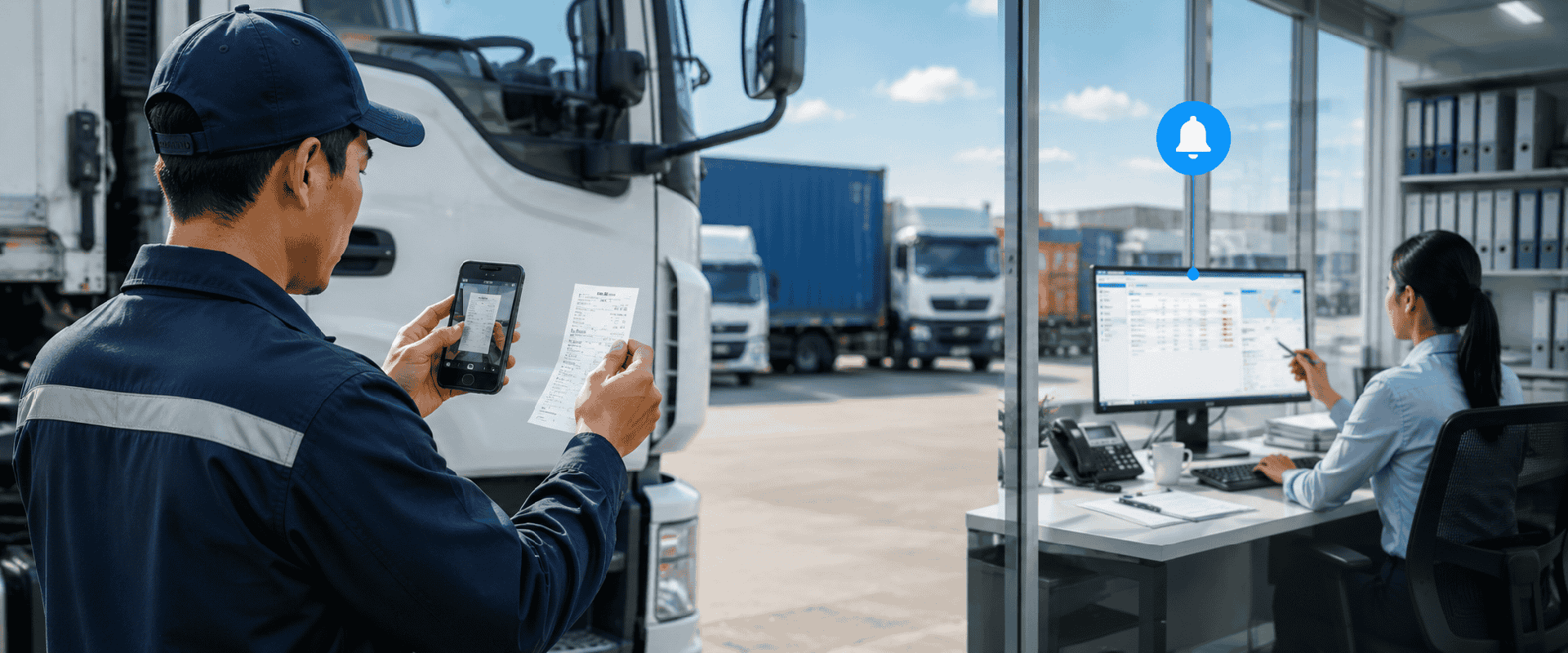
Instead of waiting for drivers to collect a stack of paper invoices at the end of the month for settlement, modern TMS applications allow drivers to take photos of parking, toll, and fuel invoices and push them directly to the system via a Mobile App. Office dispatchers can approve expenses instantly, cutting wait times by 90% and eliminating the risk of lost documents.
3.2. Tight management of COD and cash advance cash flows
In transportation cash flows, managing Cash on Delivery (COD) and en-route cash advances for drivers is highly susceptible to leakage. Technology tools provide support by:
- Tracking the process in detail: Expense Advance > Approve Advance > Issue Payment > Settlement.
- Automatically reconciling COD by trip, by driver, and by date to ensure cash flow transparency and prevent capital from being tied up.
3.3. Optimizing outsourced costs and subcontractor management
When order volumes surge beyond the capacity of the internal fleet, outsourcing becomes inevitable. The tool system must help businesses securely store transportation contracts, automatically apply freight rate tables, track the history of assigned trips, and accurately calculate Credit Notes (payments to subcontractors) to prevent incorrect payments.
3.4. Automating profit & loss (P/L) calculations and management reports
A powerful cost management tool must possess the capability to automatically allocate the shared costs of a trip to each individual order component (by km, trip, container, ton, m3 or pallet). From there, the system generates intuitive Profit & Loss (P/L) reports by day/tháng/quý/year, helping managers pinpoint exactly which trips are profitable and which customers yield the highest profit margins.
4. Comprehensive transportation management solutions from Sota Solutions
Recognizing the hidden pain points of Vietnamese transportation enterprises in controlling costs, Sota Solutions – a professional digital transformation consulting and implementation provider—has developed a comprehensive and intelligent transportation enterprise management software solution.
As part of our core management ecosystem, Sota Solutions' cost management module delivers a breakthrough thanks to its real-time synchronization features between the dispatch office and long-haul drivers:
Control operations | Smart features on Sota Solutions system | Key benefits |
Trip expense management | Drivers enter incurred expenses (fuel, tolls, parking...) along with invoice photos directly on the Mobile App (Android/iOS). | Completely eliminates hidden costs; enables instant expense approvals. |
Cash flow control | Closed-loop process: Cash Advance > Approve Advance > Issue Payment > Settlement; Automatic COD reconciliation. | 100% transparency for working cash flow, preventing capital from being tied up or leaked. |
Outsourcing management | Digitizes subcontractor contracts, automatically generates Credit Notes and Statement of Account (SOA) tables for reconciliation. | Tightens control over buying costs, optimizing profit margins. |
Profit & Loss (P/L) reports | Automatically allocates shared revenues/costs to each order; Exports multi-dimensional P/L files (by vehicle, driver, customer). | Provides business owners with a real-time financial picture to make accurate business decisions. |
More than just a packaged software provider, Sota Solutions accompanies businesses as a strategic partner. We offer tailored process consulting, support multi-language and multi-currency integration, automatically update exchange rates from major commercial banks, and stand ready to connect with electronic invoice systems (MISA, VNPT, Viettel...) to optimize your entire operational chain.

5. Conclusion
Transportation cost management has never been an easy task, but with the right approach and the support of suitable technological tools, businesses can completely transform cost pressures into a core competitive advantage. Digitizing the cost management process is the golden key that helps logistics enterprises achieve sustainable growth in the digital era.
ARE YOU READY TO OPTIMIZE 20% OF YOUR FLEET'S OPERATIONAL COSTS?
Let the experts at Sota Solutions survey and consult on the most suitable digital transformation solution for your business. Contact us today to experience the new generation demo of the Sota TMS Intelligent Transportation Management System thế hệ mới!