1. What is CRM? The core definition in the digital era
In corporate management, CRM (Customer Relationship Management) is far more than just software for storing phone numbers or emails. It is a comprehensive business strategy designed to understand, engage, and maintain enduring relationships with customers.
For the service industry, especially Logistics, CRM serves as the "heart" of the data ecosystem. It enables enterprises to track the entire lifecycle of a shipment: from the initial Quotation to the issuance of the Bill of Lading, and ultimately, ensuring customer satisfaction upon delivery.

2. The difference between general CRM and specialized CRM for logistics
Many transportation enterprises embarking on digital transformation often make the mistake of choosing a General CRM. While these platforms excel at managing the Sales Funnel, they often "fall short" when dealing with the specialized operations of the Freight Forwarding and Logistics industry.
Complex rate management
A standard CRM manages products with fixed pricing. However, in logistics, freight rates fluctuate daily and seasonally, depending on carriers and airlines. A specialized CRM allows for the management of diverse price lists—ranging from Ocean Freight (O/F) and Air Freight (A/F) to various Local Charges—enabling sales staff to generate instant quotes with just a few clicks.
Multi-departmental coordination
Logistics is a chain of coordination between Sales, Ops (Documentation), Accounting, and Suppliers. A general CRM typically stops at handing over a "Lead" to the sales closing team. In contrast, a specialized Logistics CRM connects data directly with the operations department, facilitating real-time shipment tracking without the need for manual reporting.

3. Why logistics enterprises should avoid general CRM?
Here are the three typical "pain points" when businesses attempt a "one-size-fits-all" approach by using multi-industry CRMs:
- Lack of shipment tracking capabilities: Standard CRMs lack essential data fields such as Container Number, Seal Number, ETA (Estimated Time of Arrival), ETD (Estimated Time of Departure), or Vessel Name. Customizing these fields in a general CRM is often prohibitively expensive and lacks synchronization with global shipping data.
- Difficulties in calculating profit margins: In logistics, profit is typically derived from the spread between the selling price and the buying costs from multiple vendors for a single shipment. General CRMs struggle to automatically break down and analyze these profit details, leading to financial transparency issues.
- Disconnected from operational systems: If a CRM does not "speak the language" of the transport industry, customer data becomes isolated from customs clearance software or FMS (Freight Management Systems). This silos the information, resulting in redundant data entry and a high risk of manual errors.
4. Breakthrough benefits of using a specialized logistics CRM
By implementing a system tailor-made for the shipping industry, enterprises will witness a significant transformation in operational performance:
Optimizing the logistics sales funnel
The system enables customer segmentation based on specific Routes, Commodities, or Modes of Transport (Sea/Air/Land). Consequently, the Marketing team can deliver targeted promotional campaigns to specific groups—such as clients frequently shipping to US or European routes—rather than sending generic, mass communications.
Automated reporting and forecasting
Instead of waiting until the end of the month for accounting to compile data, a specialized CRM provides instantaneous sales reports categorized by individual sales representatives, agents, or target markets. This empowers leadership to make timely decisions regarding pricing adjustments or business strategies in response to the volatile fluctuations of the global transport market.

5. "Must-have" features in a logistics CRM
If you are searching for a solution, ensure the system possesses the following essential features:
- Quote-to-Cash Management: Integrated with industry-standard quotation templates specifically designed for logistics services.
- Agent Management: Track performance and efficiency of overseas partners, along with their respective commission structures.
- Intelligent Alert System: Automated reminders for contract expirations, vessel departure dates (ETD), or urgent customer complaints.
- Omnichannel Integration: Seamlessly connect with Email, Zalo, and Websites to automatically capture and centralize RFQs (Request for Quotations).
6. Sota CRMlog – The ultimate CRM solution for the logistics industry
Understanding the unique barriers faced by Vietnamese transport enterprises, Sota CRMlog was developed as an in-depth management system to fundamentally bridge the gap between sales and operations. Moving beyond simple data storage, Sota CRMlog enables the complete digitalization of workflows—from initial lead engagement and multimodal quote management to real-time logistics business analytics. With an intuitive interface and the flexibility to scale according to business size, Sota CRMlog serves as a powerful "assistant." It empowers Freight Forwarders to break through productivity limits and project a highly professional image to global partners.
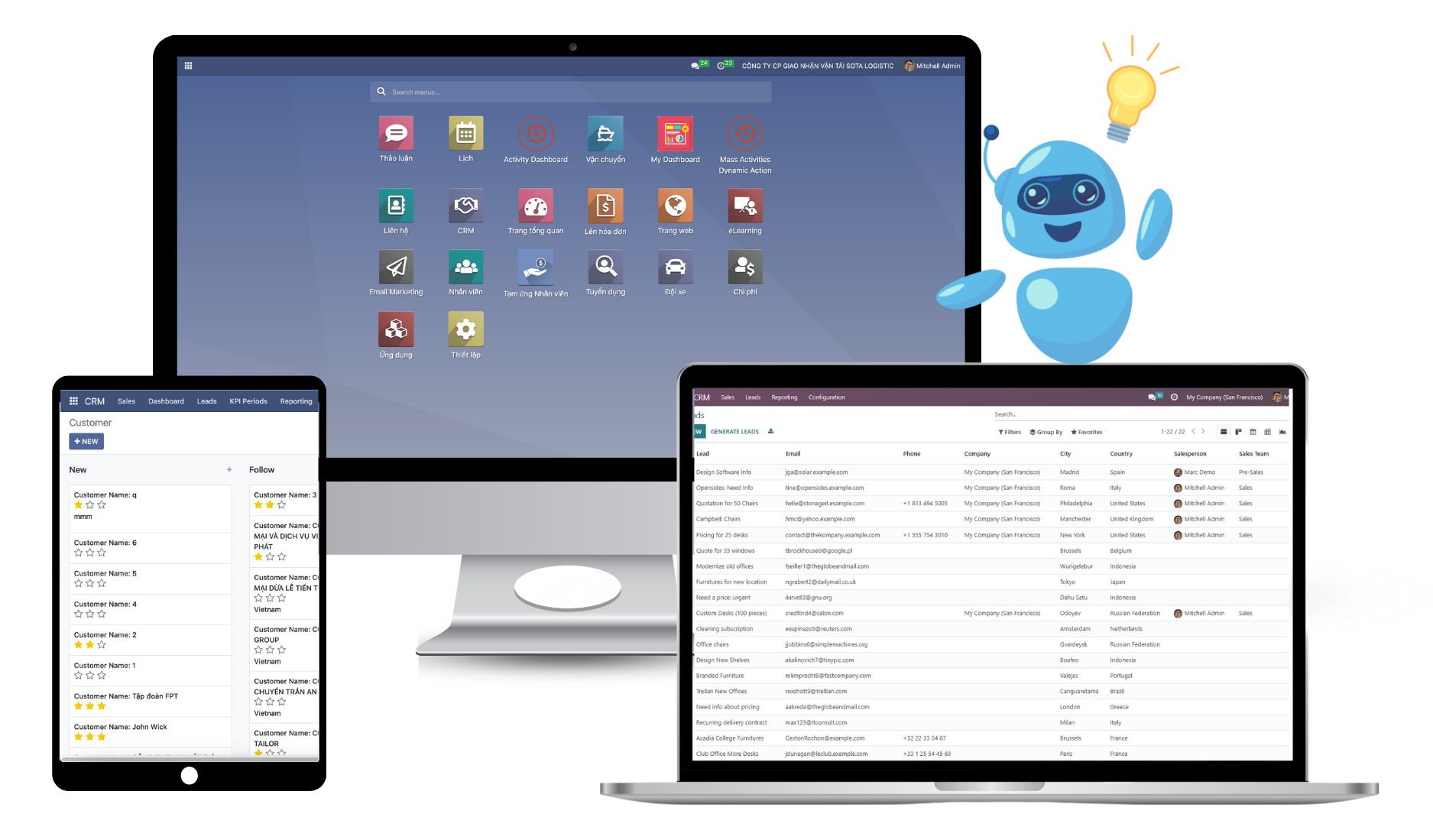
Explore the system's breakthrough features here: Sota CRMlog - Specialized CRM Solution
7. Conclusion
In the digital transformation race, choosing the right tool from the outset can save businesses billions in operating costs and implementation time. A specialized CRM for logistics is no longer just an optional add-on; it has become an essential standard for survival and growth in today’s volatile global supply chain.
It is time to say goodbye to fragmented Excel spreadsheets and bulky, one-size-fits-all CRM systems. Step into the future with a "tailor-made" solution designed specifically for your transportation business.