Once a shipment has been delivered, how long does management need to determine whether it was profitable? At companies running multiple disconnected systems, the answer usually depends on the accounting team completing reconciliation first: quotations sit with sales, actual costs sit with operations, and invoices and receivables sit with accounting. This is why a growing number of business owners are moving from standalone tools to all-in-one platforms — logistics management software that consolidates the entire workflow on a single system.
What is an All-in-one platform in logistics management?
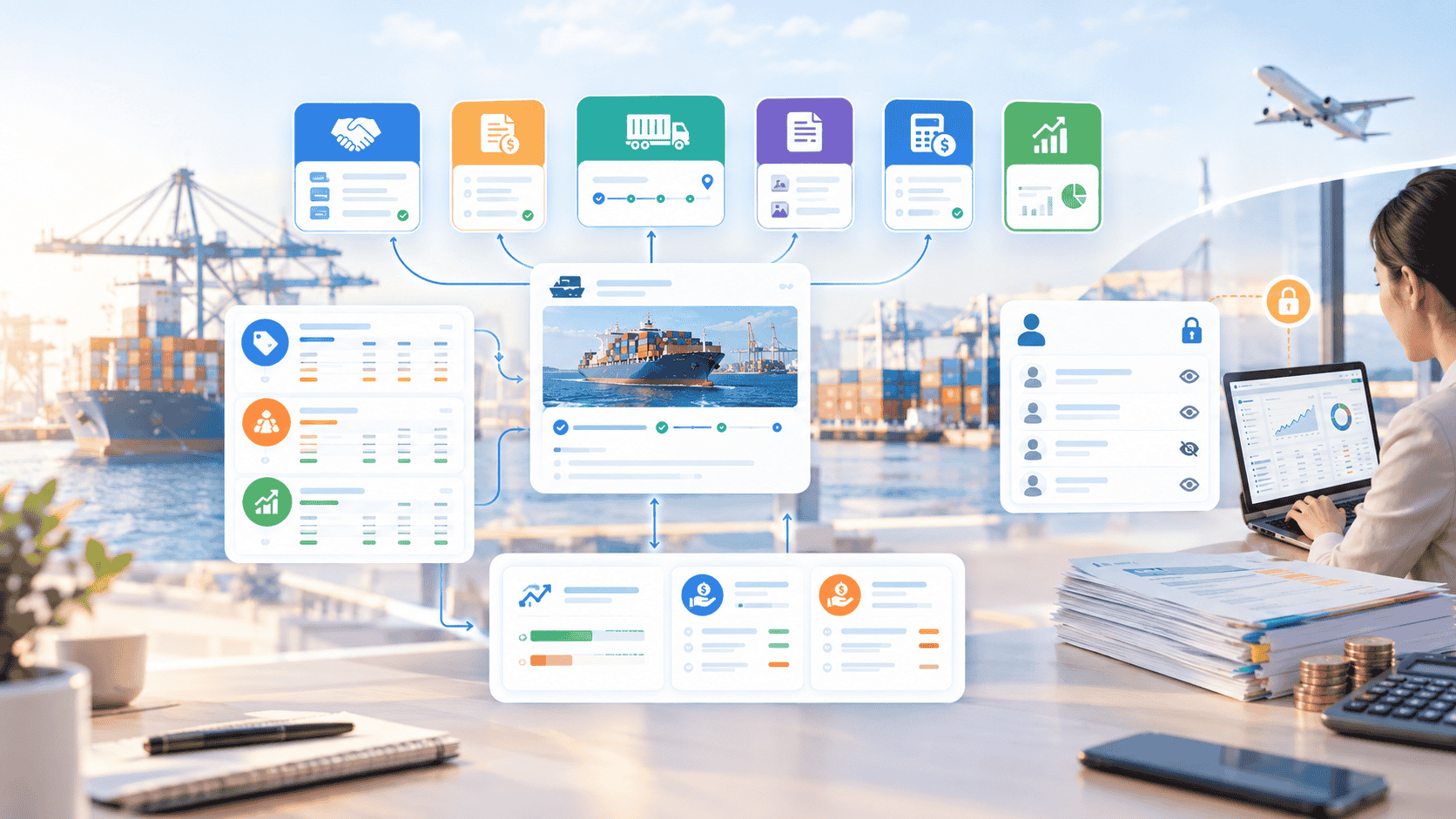
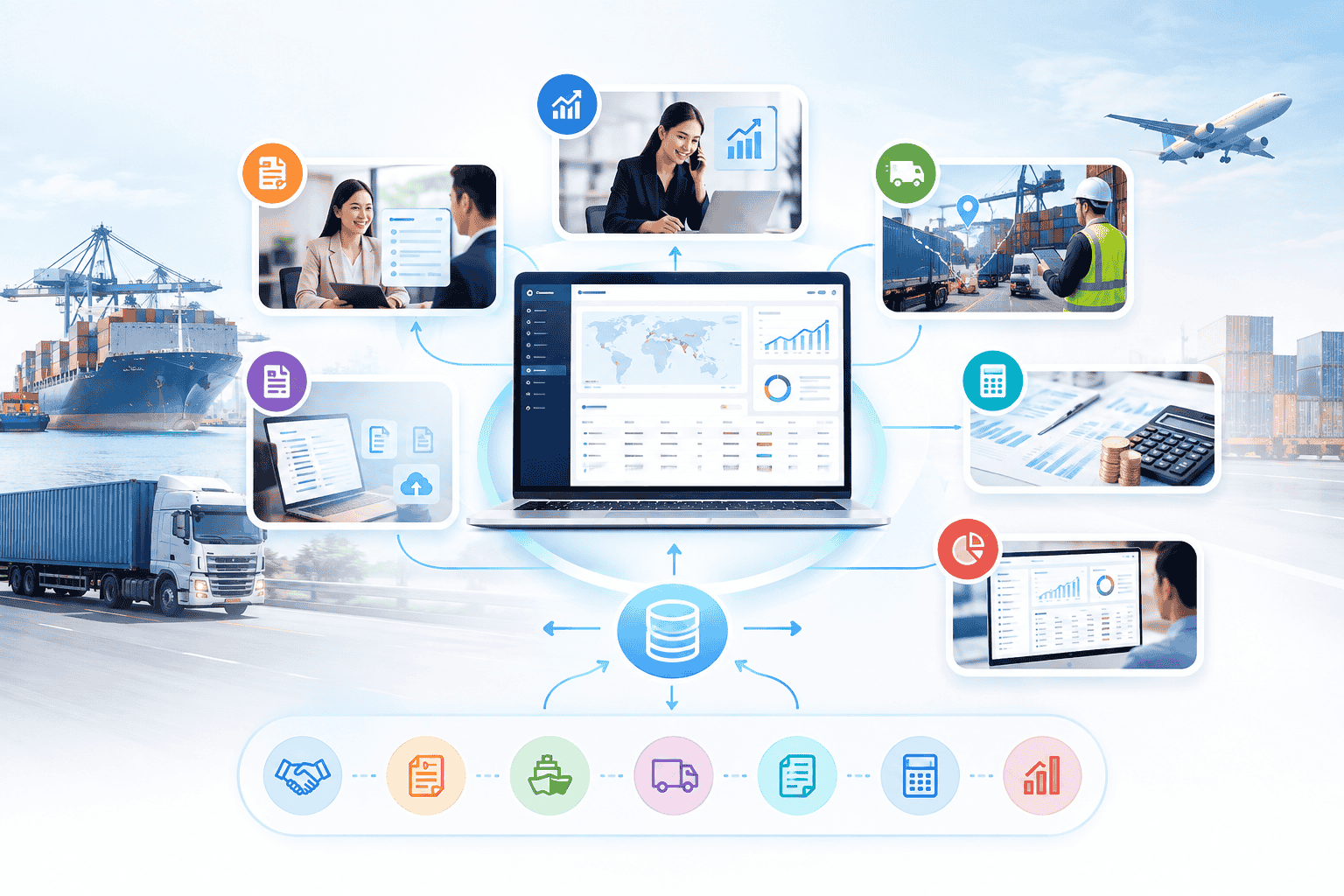
An all-in-one platform brings together a logistics company's core functions — sales, quotations, operations, documentation, accounting, and management reporting — on a single system and a single database. Its core value lies in the single-entry principle: information generated by one department is automatically carried through to every other department, with no manual re-entry or reconciliation required.
5 reasons All-in-one platforms are becoming the dominant trend
According to Softlink Global's report, The Freight Tech Stack of 2026, 2026 marks a period when the priority is eliminating system fragmentation rather than adding more tools.
1. Cost-reduction pressure demands shipment-level data
Vietnam's logistics costs currently stand at roughly 16% of GDP, higher than Malaysia (12%), Singapore (8%), and the global average (11%), according to figures the Prime Minister cited at the 2025 Vietnam Logistics Forum. Vietnam's logistics services development strategy through 2035 targets bringing this figure down to 12–15% of GDP, alongside a goal for 80% of companies in the sector to adopt digital transformation solutions. At the company level, cutting costs requires knowing exactly where costs arise, by shipment and by customer — something spreadsheets and disconnected software struggle to deliver, according to the report cited above.
2. Eliminating duplicate data entry across departments
Softlink notes that most forwarders still run operations, finance, and CRM on separate systems, stitched together with Excel. According to logistics software providers, every time the same information is re-entered, both the risk of errors and the time spent on reconciliation increase. Two situations come up repeatedly: a quotation built in Excel is retyped into the operations system, losing the underlying fee structure and margin detail; and invoice data is exported periodically just to be re-entered into accounting software.
3. Controlling profit and receivables within a single shipment record
When quotations, bookings, documents, incurred costs, and invoices are all attached to a single shipment record, a company can calculate profit or loss during operations rather than waiting until period-end. Forwarders also need to separate buying rates, internal rates, and selling rates, while restricting sales staff's visibility into cost prices. Keeping receivables and payables on the same dataset makes it possible to flag overdue payments early.
4. Standardizing processes to support scale
Most logistics companies in Vietnam are small and medium-sized. When processes depend on individual experience, opening new branches or handling higher shipment volumes tends to introduce inconsistencies in how work gets done. Standardized processes and role-based permissions on a single system allow new staff to work consistently, while management can monitor multiple branches from one dataset.
5. Unified data is a precondition for applying AI
Softlink cautions that AI in logistics only delivers results when it is embedded directly into operational workflows and built on structured, reliable data — for example, automated document processing or delay alerts. When documents, pricing, and invoices sit in separate systems, automation can only be applied to isolated parts of the process.

Specialized All-in-one solutions: How to choose the right logistics management software
According to Gartner (February 2026, on supply chain technology), specialized solutions are stronger on in-depth functionality and flexibility, while all-in-one platforms are valued for unified data and simpler vendor management. Business owners can weigh the following five criteria before selecting the right software:
- Coverage: the platform should cover the functions the company actually operates.
- Industry-specific capability: support for House B/L, Master B/L, manifests, multi-tier pricing, and cost allocation across bills of lading.
- Compliance in Vietnam: e-invoicing, VAT, and required document templates.
- Connectivity: an API to integrate with external systems when a specialized solution is needed.
- Permissions and support: role-based access control, remote access, training, and implementation support.
Before a full rollout, it is advisable to pilot the system on one trade lane, one customer, and one complete cycle from quotation to accounting entry. The system meets the requirement if a shipment can move through the entire cycle without relying on an intermediate spreadsheet.
One system for every department: The Sota FMS example
Sota FMS, management software built for logistics companies and freight forwarders, illustrates this model of managing every department on a single system:
- Sales: CRM, staff KPI tracking, quotations that compare buying and selling rates, and shipment profitability preview.
- Operations: converting quotations into bookings; job management, House B/L, Master B/L, e-manifest; AI OCR that reads bookings to populate job information.
- Documentation: invoices, packing lists, C/O, and D/O stored centrally and linked to each job.
- Accounting: debit notes and credit notes linked to shipments; financial accounting, VAT, and e-invoicing.
- Management reporting: profit-and-loss reports by shipment and by sales representative.
Frequently asked questions
Does a small logistics company need an all-in-one platform?
It is worth evaluating when several departments handle the same shipment, when the company currently relies on Excel or disconnected software, or when shipment-level profitability is unclear. Very small companies can start with a narrower scope and expand from there.
Does an all-in-one platform fully replace other software?
Not necessarily. An integrated platform handles core operations, while more specialized needs — such as complex warehouse management — can be connected through an API.
What should a company prepare before moving from Excel to integrated logistics management software?
It helps to standardize customer and vendor records, rate tables, document templates, and current workflows first, then pilot the system on a small group of shipments before a broader rollout.
Conclusion
All-in-one platforms have become the dominant trend because they directly address three problems: scattered data, shipment-level profitability that is difficult to determine, and processes that are hard to standardize as a company scales. Actual results still depend on choosing logistics management software suited to the company's operations and size. Business owners interested in managing sales, operations, documentation, and accounting on a single system can learn more about Sota FMS r request a consultation for an assessment based on their actual workflow.